
Week 9: High Availability and Fault Tolerance — “Keep the pipeline alive when things break”
Ace your next tech interview. Choose from over 30+ role-specific kits packed with system design workbooks, behavioral STAR scripts, and AI mock simulators. Pay once, get lifetime updates. 👇 Find Your Role-Specific Kit
What we’re building today
When Stripe’s payment logs stall during a region outage, engineers don’t restart everything manually—they rely on failover, circuit breakers, and backpressure working together. Netflix’s Chaos Monkey proves resilience by breaking things on purpose. This week you wire five resilience layers into one platform.
By the end you’ll have:
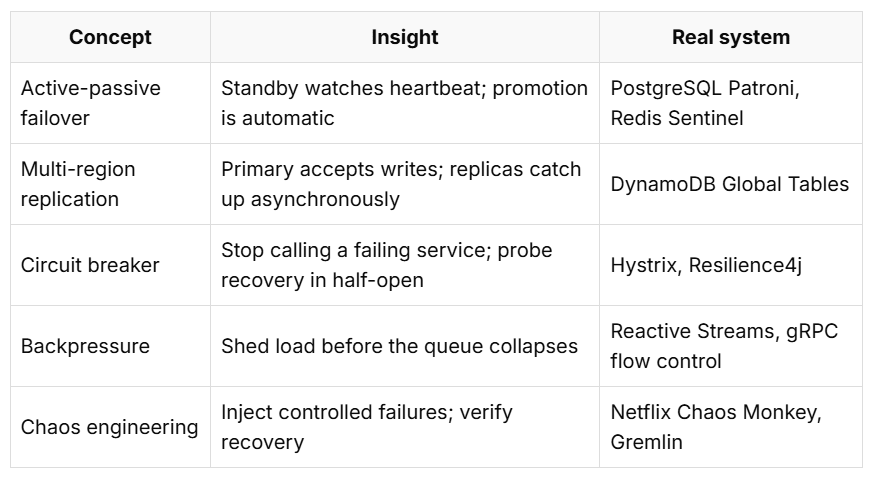
Active-passive failover with heartbeat election
Multi-region log replication across three regions
Circuit breakers protecting the processing pipeline
Adaptive backpressure under load spikes
In-process chaos injection and recovery
This project integrates resilience patterns from prior lessons without modifying those source directories.
Why this matters
AWS Route 53 health checks promote a standby when the primary fails—the same active/passive pattern you build here.
CockroachDB and Spanner replicate writes across regions with measurable lag—your replication controller mirrors that model.
Netflix Hystrix (and modern Resilience4j) trip circuits when downstream services fail—the same state machine idea.
Kafka consumer lag triggers throttling in production pipelines—your pressure levels map directly to that behavior.
Chaos Monkey randomly kills instances to prove recovery—your chaos engine does this safely in-process.
Resilience is not one feature—it is a stack of cooperating mechanisms.
Core concepts
Architecture
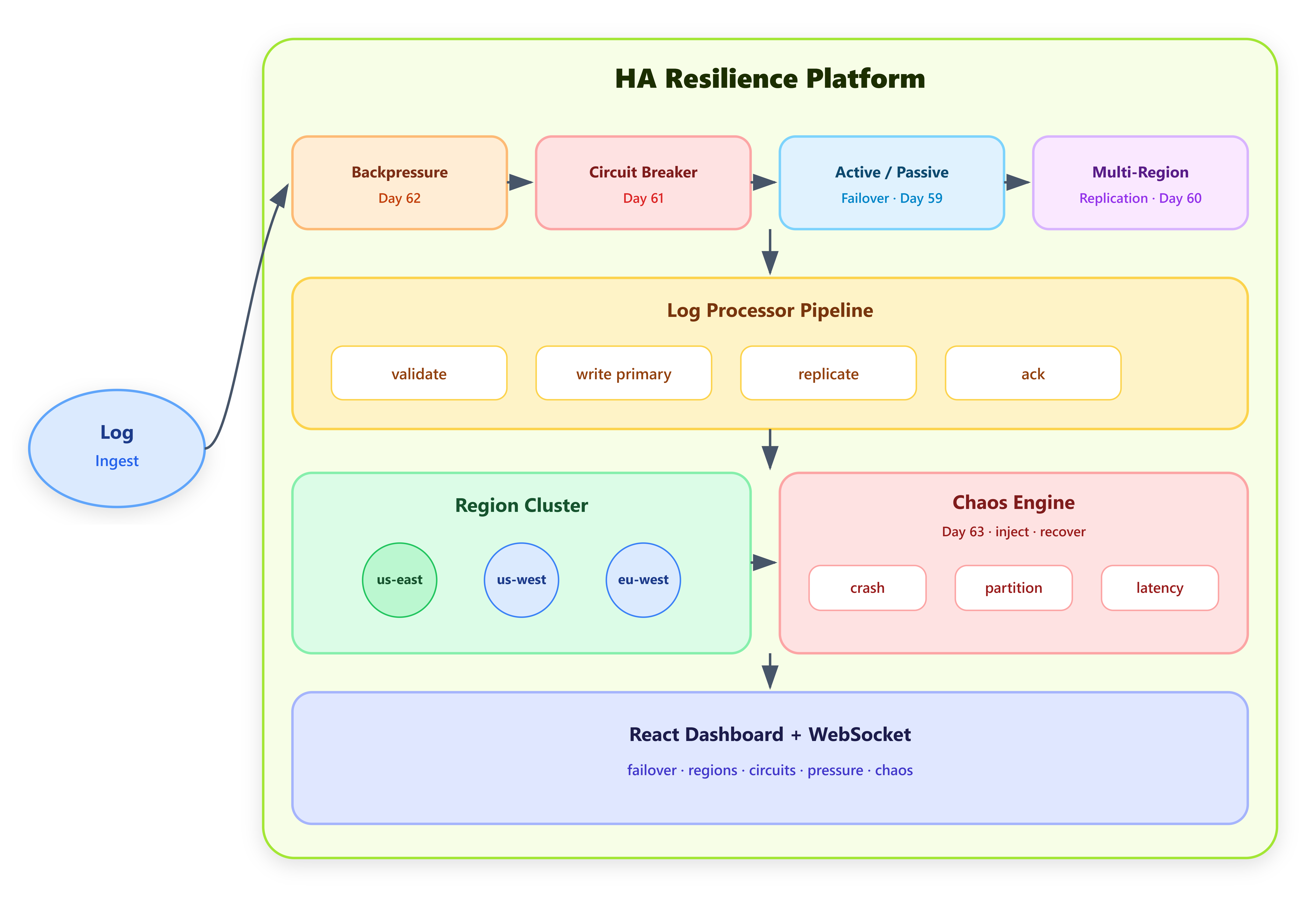
Single FastAPI service on port 8093. All resilience components run in-process—same coordination logic as a distributed production stack without extra containers for learning.
Preparing for a distributed systems interview?
→Download the free Interview Pack
→ Subscribe now to access source code repository - 200 + coding lessons
