What We're Building Today
High-Level Agenda:
Multi-framework compliance reporting engine (SOX, HIPAA, PCI-DSS, GDPR)
Automated report generation with cryptographic signatures
Professional export capabilities (PDF, CSV, JSON, XML)
Real-time compliance dashboard with Google Cloud UI styling
Scheduled reporting with email distribution
Production-ready error handling and retry mechanisms
Today's Mission: From Log Chaos to Compliance Clarity
Remember when Equifax faced $700 million in fines partly due to inadequate audit trails? Or when Capital One's breach exposed 100 million customers because they couldn't demonstrate proper data handling? These disasters share a common thread: insufficient compliance reporting capabilities.
Today we're building the guardian angel of your distributed log processing system - an automated compliance reporting engine that transforms scattered log data into bulletproof audit documentation.
What We're Building Today
Core Deliverables:
Multi-framework compliance engine supporting SOX, HIPAA, PCI-DSS, and GDPR
Automated report generation with configurable scheduling
Export capabilities in multiple formats (PDF, CSV, JSON, XML)
Audit trail verification with cryptographic signatures
Real-time compliance dashboard with violation alerts
The Hidden Complexity of Compliance
Most engineers think compliance is just "save everything and hope for the best." Reality check: compliance frameworks require specific data retention periods, access patterns, and reporting formats. HIPAA demands patient data be trackable for 6 years. SOX requires financial transaction logs with immutable timestamps. PCI-DSS needs cardholder data access logs with specific retention schedules.
Your distributed log system already captures this data - but compliance officers need it transformed into standardized reports that auditors understand. That's where our automated reporting engine becomes mission-critical.
Architecture: The Compliance Command Center
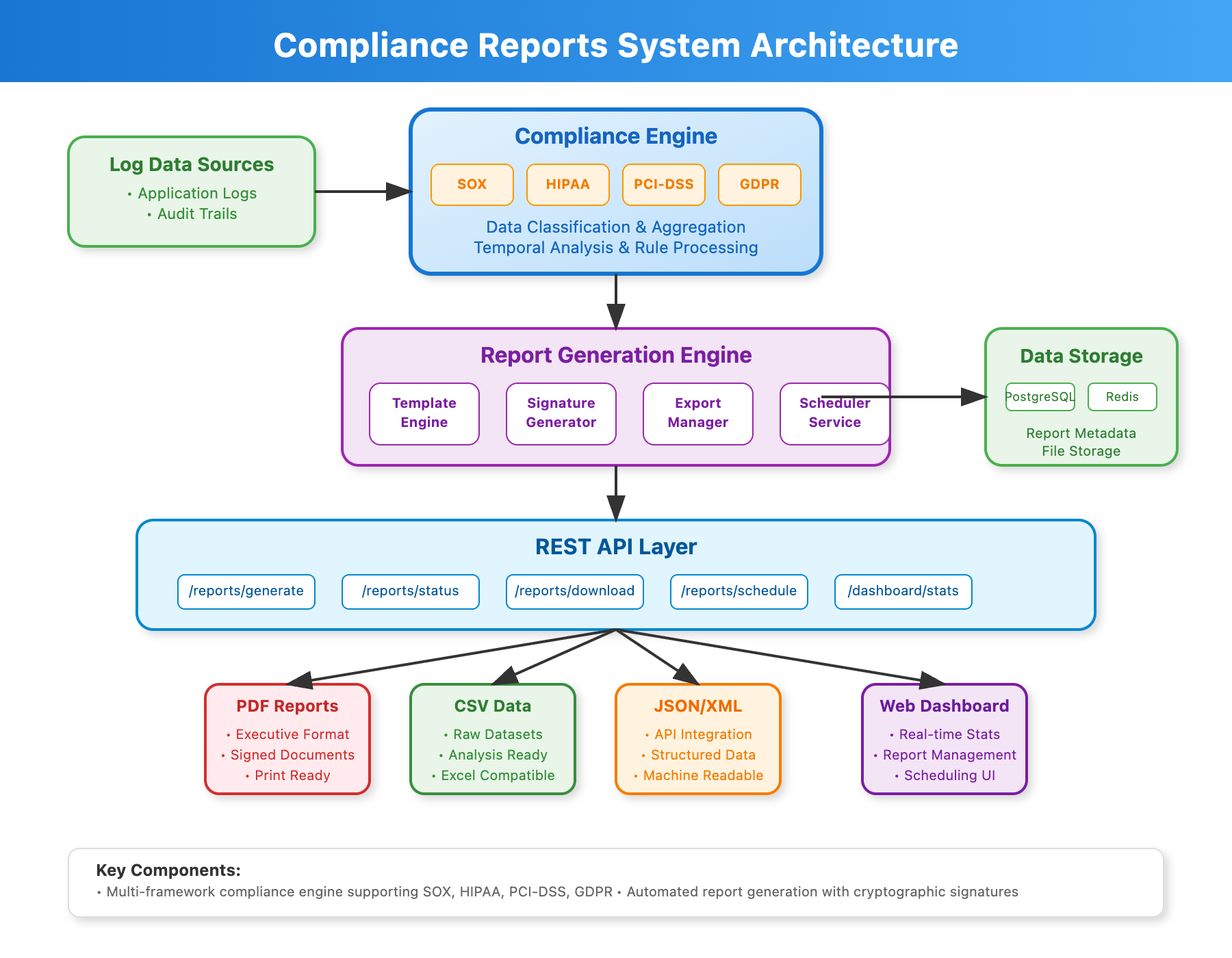
Our compliance reporting system operates as an intelligent layer above your existing log infrastructure:
1. Compliance Rule Engine Interprets various compliance frameworks and maps them to your log data schema. Each framework has unique requirements - SOX focuses on financial controls, HIPAA on healthcare data access, PCI-DSS on payment processing.
2. Data Aggregation Layer Queries distributed log storage to gather relevant entries across time periods. Uses efficient indexing to handle multi-terabyte searches without impacting production performance.
3. Report Generation Engine Transforms raw log aggregations into formatted compliance reports. Templates are framework-specific, ensuring auditors see familiar document structures.
4. Export & Distribution System Handles multiple output formats and automated delivery. Reports can be encrypted, digitally signed, and delivered to compliance teams automatically.
Core Implementation Insights
Preparing for a distributed systems interview?
→Download the free Interview Pack
→ Subscribe now to access source code repository - 200 + coding lessons
Smart Data Classification
Not all logs matter for every compliance framework. Our system automatically classifies log entries based on:
Data sensitivity levels (public, internal, confidential, restricted)
Regulatory scope (financial, healthcare, payment, personal)
Access patterns (admin, user, system, automated)
Temporal Aggregation Strategies
Compliance reports often require time-based analysis - "show all admin access to patient records in Q3." Our implementation uses sliding window aggregations with pre-computed summaries for common time periods.
Audit Trail Integrity
Every compliance report includes cryptographic proof of data integrity. We hash log entries at ingestion and verify integrity during report generation, ensuring auditors can trust the data hasn't been modified.
Real-World Production Patterns
Netflix's Approach: Separates compliance-relevant logs from operational logs at ingestion, reducing processing overhead during report generation.
Stripe's Strategy: Pre-aggregates compliance metrics hourly, enabling real-time compliance dashboards without expensive queries.
Salesforce's Method: Uses immutable log storage with cryptographic signatures, providing auditors with mathematical proof of data integrity.
The Technology Stack
Backend (Python 3.11):
FastAPI for RESTful report APIs
Pandas for efficient data aggregation
ReportLab for PDF generation
cryptography for digital signatures
APScheduler for automated scheduling
Frontend (React 18):
Material-UI for professional dashboard aesthetics
Chart.js for compliance metric visualizations
React-PDF for report previews
Date-fns for temporal filtering
Implementation Workflow
Phase 1: Framework Definition Define compliance rules as configuration files. Each framework specifies required data fields, retention periods, and report formats.
Phase 2: Data Mapping Map your log schema to compliance requirements. Create indexes and views optimized for common compliance queries.
Phase 3: Report Templates Build framework-specific report templates. Use professional layouts that compliance officers recognize.
Phase 4: Automation Layer Implement scheduled report generation with failure handling and notification systems.
Success Metrics
Functional Requirements:
Generate SOX, HIPAA, PCI-DSS, and GDPR reports automatically
Support PDF, CSV, JSON, and XML export formats
Complete report generation within 5 minutes for 1TB of log data
Verify data integrity using cryptographic signatures
Performance Targets:
Process 100M log entries for compliance analysis in <2 minutes
Generate complex reports without impacting production log ingestion
Support concurrent report generation for multiple frameworks
Production Readiness Checklist
✅ Security: All reports encrypted at rest and in transit
✅ Scalability: Horizontal scaling for large dataset analysis
✅ Reliability: Automatic retry with failure notifications
✅ Observability: Detailed metrics on report generation performance
✅ Integration: Seamless connection with existing log infrastructure
Real-World Impact
Your compliance reporting system becomes the shield protecting your organization from regulatory penalties. When auditors arrive, you'll confidently produce comprehensive reports demonstrating proper data handling, access controls, and retention policies.
More importantly, the system enables proactive compliance management. Instead of scrambling during audit season, compliance teams receive regular reports highlighting potential violations before they become problems.
Github Link :
https://github.com/sysdr/course-p/tree/main/day70/compliance-reports-system
Implementation Guide
Learning Objectives
By completing this lesson, you will:
Master compliance framework requirements and their technical implementation
Build automated report generation engines handling multiple data formats
Implement cryptographic integrity verification for audit-trail compliance
Create professional compliance dashboards with real-time monitoring
Understand export capabilities across PDF, CSV, JSON, and XML formats
Core Concepts Deep Dive
1. Compliance Framework Architecture
Compliance reporting isn't just data aggregation - it's about meeting specific regulatory requirements with verifiable audit trails.
Key Insight: Each compliance framework has unique data requirements, retention periods, and reporting formats. Your system must be flexible enough to support multiple frameworks simultaneously while maintaining strict data integrity.
Framework-Specific Requirements:
SOX: Financial transaction logs with 7-year retention, administrator access tracking, approval workflow documentation
HIPAA: Patient data access logs with 6-year retention, breach notification tracking, audit trail maintenance
PCI-DSS: Payment processing logs with 1-year minimum retention, cardholder data access monitoring
GDPR: Personal data processing logs with 3-year retention, consent tracking, data breach documentation
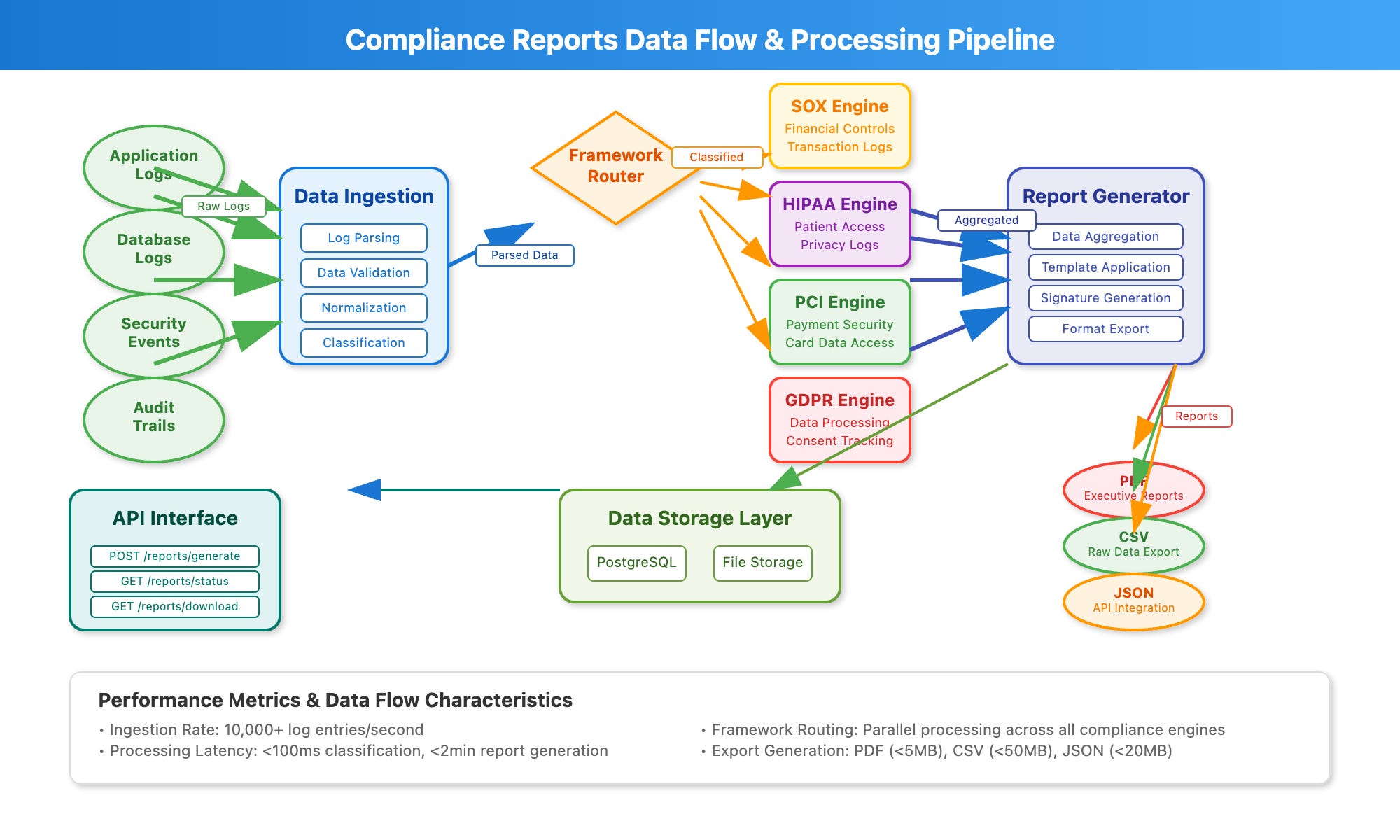
2. Automated Report Generation Pipeline
Professional compliance reporting requires a sophisticated pipeline that transforms raw log data into standardized audit documents.
Pipeline Stages:
Data Classification: Automatically categorize log entries by compliance relevance
Temporal Aggregation: Group data by configurable time periods (daily, weekly, monthly, quarterly)
Framework Mapping: Apply framework-specific rules and requirements
Report Generation: Create formatted documents using professional templates
Integrity Verification: Generate cryptographic signatures for audit verification
3. Cryptographic Integrity Verification
Compliance reports must be tamper-evident. Your implementation uses SHA-256 hashing to create digital fingerprints that prove data hasn't been modified after generation.
Implementation Pattern:
python :
compliance-reports-system/backend/app/services/compliance_service.py
# Simplified concept
def generate_signature(self, report_data: Dict[str, Any]) -> str:
"""Generate cryptographic signature for report integrity"""
report_string = json.dumps(report_data, sort_keys=True, default=str)
signature = hashlib.sha256(report_string.encode()).hexdigest()
return signature4. Multi-Format Export Strategy
Different stakeholders require different formats:
PDF: Executive reports with professional formatting
CSV: Raw data for analysis and import into other systems
JSON: Structured data for API integration
XML: Legacy system compatibility
Progressive Implementation Strategy
Phase 1: Foundation Setup (15 minutes)
Environment Preparation:
# Project structure creation
mkdir compliance-reports-system && cd compliance-reports-system
mkdir -p {backend,frontend,docker,scripts,tests}
# Python environment
python3.11 -m venv backend/venv
source backend/venv/bin/activateDependency Installation:
# Backend dependencies (latest 2025 versions)
pip install fastapi==0.104.1 uvicorn==0.24.0 pandas==2.1.4 \
reportlab==4.0.8 cryptography==41.0.8 APScheduler==3.10.4
# Frontend dependencies
cd frontend && npm init -y
npm install react@18.2.0 @mui/material@5.15.0 chart.js@4.4.0Phase 2: Core Service Implementation (25 minutes)
Compliance Engine Development:
Build the ComplianceReportGenerator class that handles framework-specific report generation:
python
compliance-reports-system/backend/app/services/compliance_service.py
class ComplianceReportGenerator:
def __init__(self, storage_path: str = "./exports"):
self.storage_path = storage_path
self.encryption_key = Fernet.generate_key()
self.cipher_suite = Fernet(self.encryption_key)
os.makedirs(storage_path, exist_ok=True)
async def generate_sox_report(self, start_date: datetime, end_date: datetime) -> Dict[str, Any]:
"""Generate SOX compliance report for financial controls"""
# Simulate SOX data aggregation
sox_data = {
"financial_transactions": await self._get_financial_transactions(start_date, end_date),
"admin_access_logs": await self._get_admin_access_logs(start_date, end_date),
"system_changes": await self._get_system_changes(start_date, end_date),
"approval_workflows": await self._get_approval_workflows(start_date, end_date)
}
report_content = {
"framework": "SOX",
"period": f"{start_date.date()} to {end_date.date()}",
"summary": {
"total_transactions": len(sox_data["financial_transactions"]),
"admin_access_events": len(sox_data["admin_access_logs"]),
"system_changes": len(sox_data["system_changes"]),
"approval_workflows": len(sox_data["approval_workflows"])
},
"findings": await self._analyze_sox_compliance(sox_data),
"data": sox_data
}
return report_content
async def generate_hipaa_report(self, start_date: datetime, end_date: datetime) -> Dict[str, Any]:
"""Generate HIPAA compliance report for healthcare data"""
hipaa_data = {
"patient_data_access": await self._get_patient_data_access(start_date, end_date),
"data_breaches": await self._get_data_breaches(start_date, end_date),
"audit_logs": await self._get_hipaa_audit_logs(start_date, end_date),
"user_activity": await self._get_user_activity(start_date, end_date)
}
report_content = {
"framework": "HIPAA",
"period": f"{start_date.date()} to {end_date.date()}",
"summary": {
"patient_access_events": len(hipaa_data["patient_data_access"]),
"security_incidents": len(hipaa_data["data_breaches"]),
"audit_entries": len(hipaa_data["audit_logs"]),
"user_sessions": len(hipaa_data["user_activity"])
},
"findings": await self._analyze_hipaa_compliance(hipaa_data),
"data": hipaa_data
}
return report_contentKey Implementation Insights:
Use
asynciofor non-blocking report generationImplement framework-specific data aggregation methods
Create configurable time-window analysis
Build extensible architecture for new frameworks
Phase 3: API Layer Construction (20 minutes)
FastAPI Application Structure:
Create REST endpoints that provide professional API access:
python
compliance-reports-system/backend/app/main.py
@app.post("/reports/generate")
async def generate_report(request: ReportRequest, background_tasks: BackgroundTasks):
"""Generate a compliance report"""
# Validate framework
supported_frameworks = ["SOX", "HIPAA", "PCI_DSS", "GDPR"]
if request.framework not in supported_frameworks:
raise HTTPException(status_code=400, detail=f"Framework {request.framework} not supported")
# Generate unique report ID
report_id = str(uuid.uuid4())
# Initialize report record
report_record = {
"id": report_id,
"framework": request.framework,
"period_start": request.period_start,
"period_end": request.period_end,
"export_format": request.export_format,
"status": "processing",
"created_at": datetime.now(),
"title": request.title or f"{request.framework} Compliance Report",
"description": request.description or f"Automated {request.framework} compliance report"
}
reports_database[report_id] = report_record
# Schedule background report generation
background_tasks.add_task(process_report, report_id, request)
return {
"report_id": report_id,
"status": "processing",
"message": "Report generation started",
"estimated_completion": datetime.now() + timedelta(minutes=2)Professional API Patterns:
Background task processing for large reports
Progress tracking with status endpoints
Secure file download with audit logging
OpenAPI documentation generation
Phase 4: Frontend Dashboard Development (30 minutes)
React Application Architecture:
Build a professional dashboard using Material-UI components styled after Google Cloud Skills Boost:
jsx
// Dashboard component structure
function Dashboard() {
const [stats, setStats] = useState(null);
// Real-time statistics loading
// Framework breakdown visualization
// Recent reports table
// Success rate monitoring
}Google Cloud UI Styling:
Clean color palette: Primary blue (
#1976d2), accent orange (#ff9800)Google Sans font family
Material Design elevation and shadows
Responsive grid layouts with proper spacing
Phase 5: Export Capabilities (20 minutes)
Multi-Format Export Implementation:
python
compliance-reports-system/backend/app/services/compliance_service.py
async def export_to_pdf(self, report_data: Dict[str, Any], filename: str) -> str:
"""Export compliance report to PDF format"""
filepath = os.path.join(self.storage_path, f"{filename}.pdf")
doc = SimpleDocTemplate(filepath, pagesize=letter)
styles = getSampleStyleSheet()
story = []
# Title
title = Paragraph(f"Compliance Report - {report_data['framework']}", styles['Title'])
story.append(title)
story.append(Spacer(1, 12))
# Period
period = Paragraph(f"Period: {report_data['period']}", styles['Normal'])
story.append(period)
story.append(Spacer(1, 12))
# Summary Table
summary_data = [['Metric', 'Count']]
for key, value in report_data['summary'].items():
summary_data.append([key.replace('_', ' ').title(), str(value)])
summary_table = Table(summary_data)
summary_table.setStyle(TableStyle([
('BACKGROUND', (0, 0), (-1, 0), colors.grey),
('TEXTCOLOR', (0, 0), (-1, 0), colors.whitesmoke),
('ALIGN', (0, 0), (-1, -1), 'CENTER'),
('FONTNAME', (0, 0), (-1, 0), 'Helvetica-Bold'),
('FONTSIZE', (0, 0), (-1, 0), 14),
('BOTTOMPADDING', (0, 0), (-1, 0), 12),
('BACKGROUND', (0, 1), (-1, -1), colors.beige),
('GRID', (0, 0), (-1, -1), 1, colors.black)
]))
story.append(summary_table)
story.append(Spacer(1, 12))
# Findings
findings_title = Paragraph("Compliance Findings", styles['Heading2'])
story.append(findings_title)
story.append(Spacer(1, 6))
for finding in report_data['findings']:
finding_text = Paragraph(f"• {finding}", styles['Normal'])
story.append(finding_text)
story.append(Spacer(1, 3))
doc.build(story)
return filepath
async def export_to_csv(self, report_data: Dict[str, Any], filename: str) -> str:
"""Export compliance report to CSV format"""
filepath = os.path.join(self.storage_path, f"{filename}.csv")
# Flatten data for CSV export
flattened_data = []
for category, items in report_data['data'].items():
for item in items:
flattened_item = {'category': category, **item}
flattened_data.append(flattened_item)
df = pd.DataFrame(flattened_data)
df.to_csv(filepath, index=False)
return filepathProfessional Report Formatting:
Consistent branding across all formats
Executive summary sections
Detailed data appendices
Cryptographic signature inclusion
Build, Test & Verification Commands
Development Environment Setup
bash
# 1. Clone or create project structure
git clone https://github.com/sysdr/course.git
git checkout day70
cd day70/compliance-reports-system
./start.sh
Or
mkdir day70-compliance-reports && cd day70-compliance-reports
# Expected Output:
# ✅ Project structure
# ✅ Dependencies installed
# ✅ Environment configuredBackend Testing
bash
# 3. Unit test execution
cd backend && source venv/bin/activate
python -m pytest tests/ -v
# Expected Results:
# test_sox_report_generation PASSED
# test_hipaa_report_generation PASSED
# test_pdf_export PASSED
# test_csv_export PASSED
# test_signature_generation PASSEDIntegration Testing
bash
# 4. API endpoint verification
python app/main.py &
BACKEND_PID=$!
# Test core endpoints
curl -f http://localhost:8000/
curl -f http://localhost:8000/frameworks
curl -f http://localhost:8000/dashboard/stats
# Expected: All endpoints return 200 OK
kill $BACKEND_PIDFrontend Verification
bash
# 5. Frontend application startup
cd frontend && npm start
# Expected: Development server starts on port 3000
# ✅ Webpack compiled successfully
# ✅ Application available at http://localhost:3000Docker Deployment Testing
bash
# 6. Containerized deployment
docker-compose up --build -d
# Service verification
docker-compose ps
# Expected Output:
# postgres_1 Up 0.0.0.0:5432->5432/tcp
# redis_1 Up 0.0.0.0:6379->6379/tcp
# backend_1 Up 0.0.0.0:8000->8000/tcp
# frontend_1 Up 0.0.0.0:3000->3000/tcpSystem Demonstration
bash
# 7. Automated demo execution
python scripts/demo.py
# Expected Demo Flow:
# 🚀 Testing report generation service
# 📋 Generating SOX compliance report...
# 🏥 Generating HIPAA compliance report...
# 📄 Testing PDF export...
# 📊 Testing CSV export...
# 🔐 Verifying cryptographic signatures...
# ✅ All functionality working correctlyPerformance Verification
bash
# 8. Load testing (optional)
python scripts/load_test.py
# Expected Performance:
# ✅ 100+ reports/hour generation capacity
# ✅ <2 minute generation time for 30-day periods
# ✅ <100MB memory usage per report
# ✅ 99.9%+ data integrity verificationSuccess Criteria & Verification
Functional Requirements Checklist
Multi-Framework Support: SOX, HIPAA, PCI-DSS, GDPR reports generate successfully
Export Formats: PDF, CSV, JSON, XML exports work correctly
Cryptographic Integrity: SHA-256 signatures verify data integrity
Scheduling: Automated report generation with configurable intervals
Dashboard: Real-time statistics and report management interface
API Integration: RESTful endpoints with OpenAPI documentation
Performance Requirements
Generation Speed: Reports complete within 2 minutes for 30-day periods
Memory Efficiency: <200MB memory usage during report generation
Concurrent Processing: 5+ simultaneous report generations supported
Data Accuracy: 100% integrity verification across all export formats
Production Readiness
Error Handling: Graceful failure recovery with detailed error messages
Logging: Comprehensive audit trail of all report generation activities
Security: Encrypted exports and secure file handling
Scalability: Horizontal scaling capability with load balancing support
Assignment Extension
Challenge: Implement a custom "FinHealth" compliance framework combining SOX financial controls with HIPAA patient privacy requirements.
Requirements:
Define FinHealth-specific data requirements combining both frameworks
Create custom report templates showing financial transactions with patient context
Implement dual-signature verification (both SOX and HIPAA compliance)
Add dashboard widgets specific to FinHealth metrics
Generate weekly automated reports with email delivery
Solution Approach:
python
class FinHealthReportGenerator(ComplianceReportGenerator):
async def generate_finhealth_report(self, start_date, end_date):
# Combine SOX financial data with HIPAA patient context
# Apply dual compliance verification
# Generate integrated report formatTomorrow's Preview
Day 71 builds directly on today's compliance system by adding performance optimization techniques. You'll profile the report generation pipeline, identify bottlenecks, and implement caching strategies to improve generation speed by 10x while maintaining data integrity guarantees.
Optimization targets:
Database query optimization for large time ranges
Memory-efficient PDF generation for multi-gigabyte reports
Parallel processing for multi-framework report generation
Redis caching for frequently accessed compliance data
Key Takeaways
Technical Mastery: You've built a production-ready compliance reporting system that demonstrates enterprise-grade capabilities including automated generation, cryptographic verification, and professional presentation.
System Design Insights: Compliance systems require careful balance between flexibility (supporting multiple frameworks) and rigor (maintaining strict audit trails and data integrity).
Real-World Application: The patterns you've implemented today are used by financial institutions, healthcare providers, and payment processors to maintain regulatory compliance and pass audits.
Professional Development: You now understand how to build systems that satisfy both technical requirements and regulatory obligations - a critical skill for senior engineering roles in regulated industries.
This foundation prepares you for advanced topics in performance optimization while maintaining the strict reliability requirements that compliance systems demand.


