
Day 64: Implement Role-Based Access Control for Log Data
What We’re Building Today
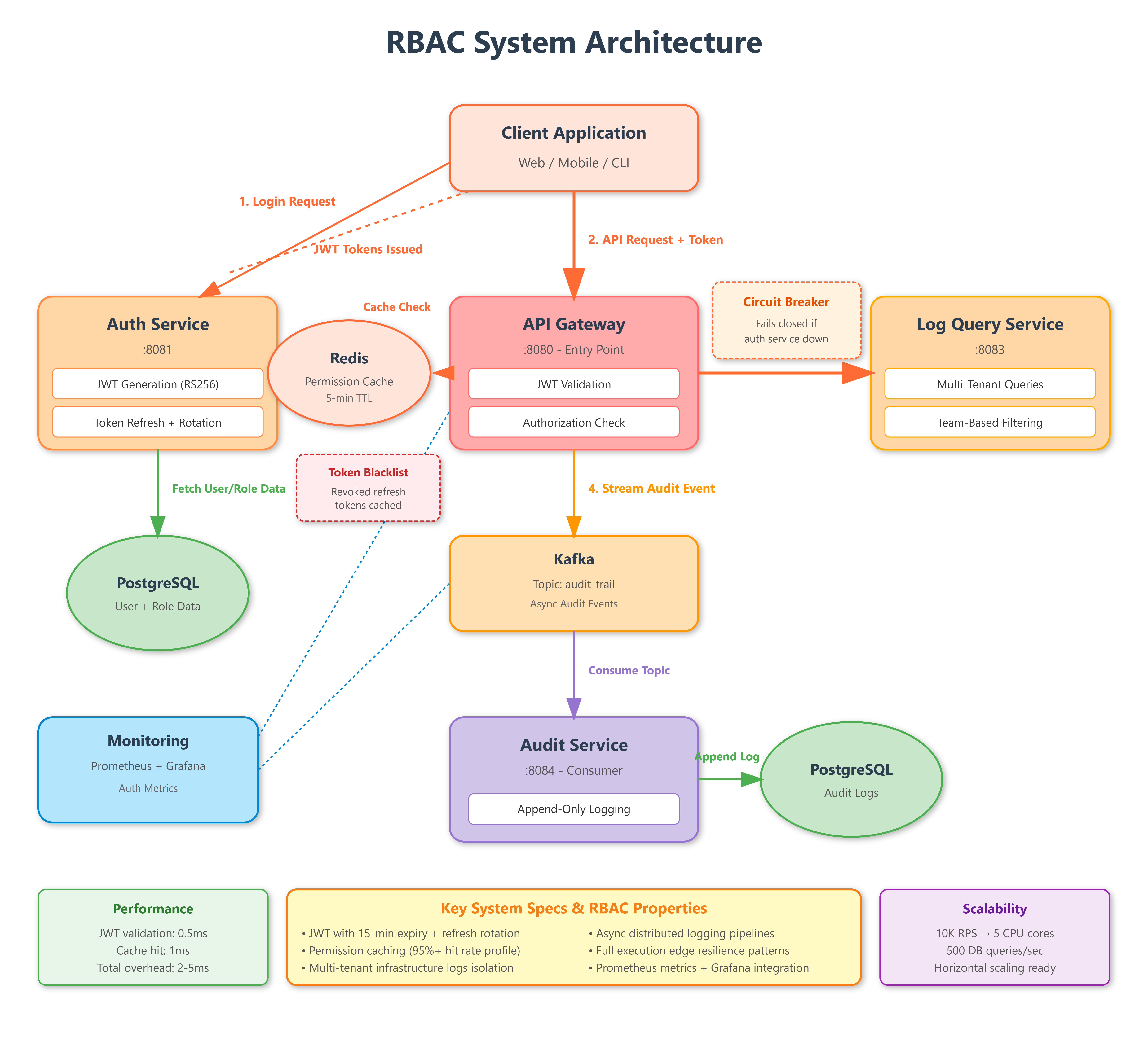
JWT-based authentication service with refresh token rotation
Fine-grained authorization middleware controlling log access by team/service
Audit logging system tracking all data access attempts
Multi-tenant isolation ensuring teams only see their logs
Why This Matters
In production log processing systems at scale, access control isn’t optional—it’s a regulatory requirement. When your system ingests millions of events per second from hundreds of microservices, you’re inevitably capturing sensitive data: user IDs, payment details, health information, internal API keys. A single unauthorized query could expose customer PII, violate GDPR/HIPAA compliance, or leak competitive intelligence.
Netflix processes 500+ billion events daily across 1,000+ microservices. Without RBAC, any engineer could query any service’s logs—a security nightmare. Uber’s data breach in 2016 partially stemmed from inadequate access controls. Modern distributed systems require defense-in-depth: authentication proves identity, authorization enforces least-privilege access, and audit trails ensure accountability.
The challenge: implementing security without sacrificing the millisecond-latency queries that make logs useful for incident response. Today’s RBAC system must scale horizontally, cache authorization decisions, and fail closed (deny access on errors) while maintaining the sub-100ms query performance engineers expect.
System Design Deep Dive
Preparing for a distributed systems interview?
→Download the free Interview Pack
→ Subscribe now to access source code repository - 200 + coding lessons
