Stop reading about architecture and start building it. Theory only gets you so far. Commit to a daily coding habit where you implement distributed systems from the ground up. No abstractions, no shortcuts—just pure engineering. Start your first lesson today. Upgrade to Lifetime Access subscription & Get one year free subscription to our hands on course portal : “systemdrd.com” that offers wide variety of hands on courses on covering multiple high demanding technologies.
What We’re Building Today
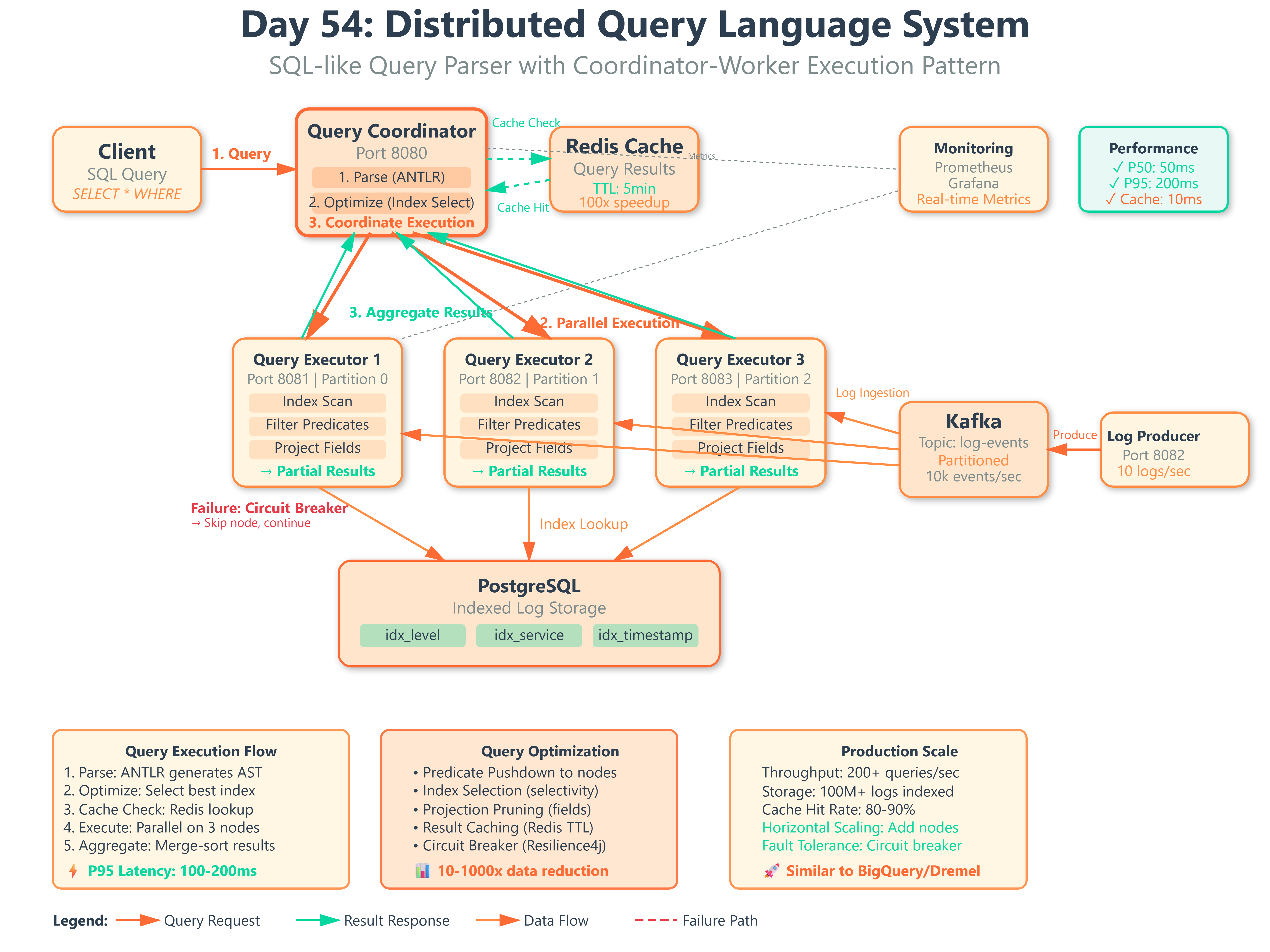
Today we’re implementing a production-grade SQL-like query language for distributed log analytics. By the end of this lesson, you’ll have:
Query Parser & Lexer: ANTLR-based parser supporting SELECT, WHERE, GROUP BY, ORDER BY, and aggregation functions
Distributed Query Executor: Coordinator that pushes query execution to indexed nodes from Day 53’s distributed index
Query Optimizer: Cost-based optimizer that rewrites queries to leverage existing indexes and minimize network traffic
Result Aggregator: Merge-sort implementation that combines partial results from multiple nodes while maintaining memory efficiency
Why This Matters
Every log analytics platform at scale needs a query interface that abstracts complexity while maintaining performance. Elasticsearch powers queries at Uber processing 10+ billion logs daily. Splunk’s Search Processing Language handles petabytes at major financial institutions. Google’s Dremel (BigQuery) executes SQL queries across distributed columnar storage.
The challenge isn’t just parsing syntax—it’s distributing execution intelligently. A naive query that scans all logs across 100 nodes will timeout. The key architectural insight: push computation to data, not data to computation. Query coordinators must rewrite queries into node-local operations, leverage distributed indexes, and aggregate results incrementally.
This lesson bridges your Day 53 distributed indexing with practical querying. Without a sophisticated query layer, your indexes are useless. Users need SQL familiarity, not custom APIs. Production query engines must handle complex predicates, joins across time windows, and real-time aggregations while maintaining sub-second latency.
System Design Deep Dive