What We’re Building Today
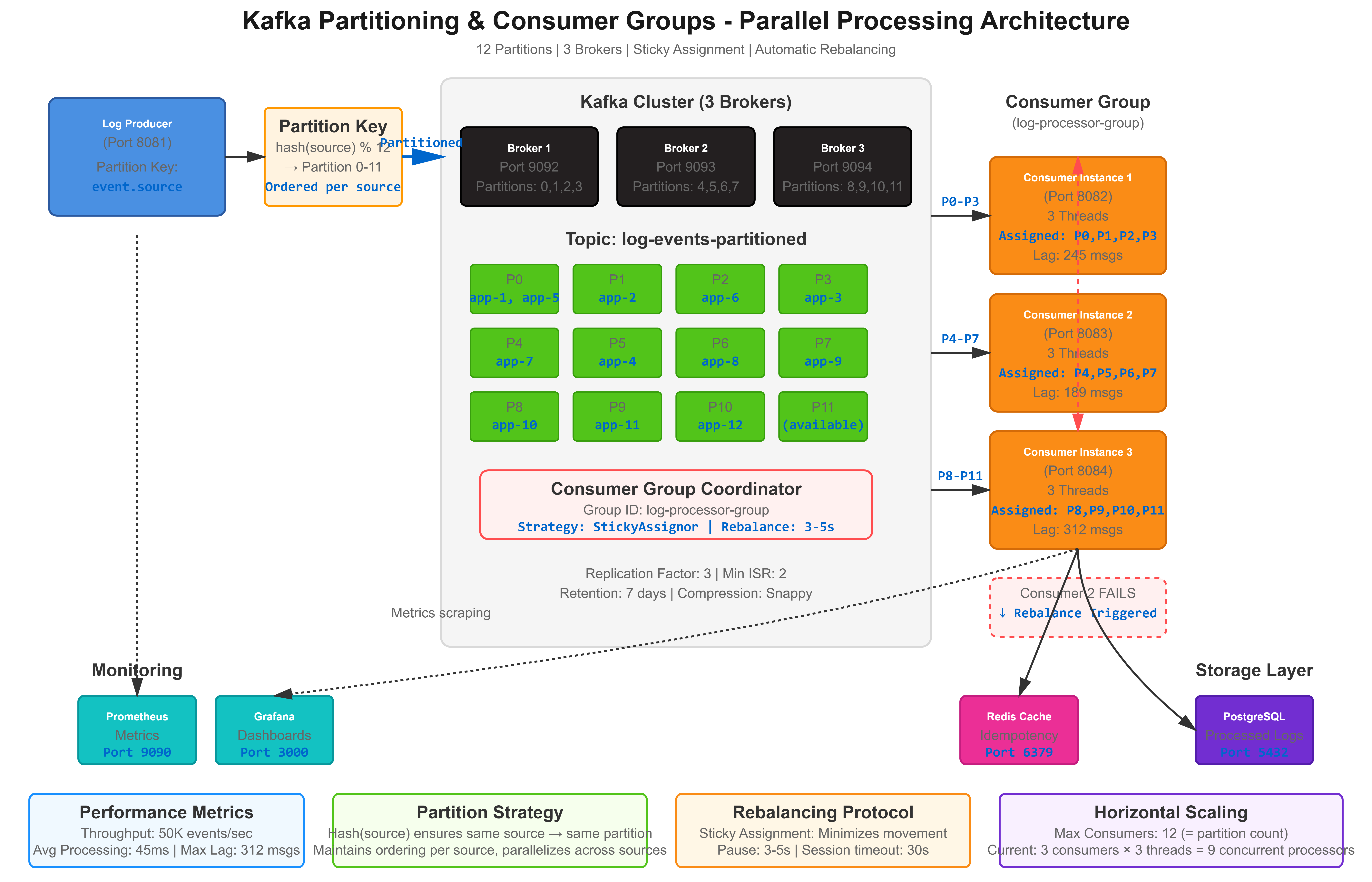
Today we implement horizontal scalability for log processing through Kafka’s partitioning and consumer group mechanisms:
Topic partitioning strategy with semantic key selection for log event distribution
Consumer group coordination enabling automatic load balancing across multiple consumer instances
Dynamic rebalancing protocols handling consumer failures and scale-out scenarios gracefully
Partition assignment strategies optimizing throughput for different log processing workloads
Why This Matters: The Parallel Processing Foundation
When Netflix processes 500 billion events daily or Uber handles 14 million trips per day, single-threaded processing isn’t an option. Kafka’s partitioning model solves the fundamental distributed systems challenge: how do we process millions of messages per second while maintaining order guarantees where they matter and maximizing parallelism everywhere else?
The architectural decision between using a single partition (strong ordering, limited throughput) versus multiple partitions (high throughput, ordering within partitions only) defines your system’s scalability ceiling. Companies like LinkedIn process 7 trillion messages daily through Kafka precisely because partitioning enables horizontal scaling - adding more consumers linearly increases processing capacity without architectural changes.
Understanding partition assignment and consumer group coordination is critical for system design interviews. When asked “how would you process 1 million events per second?”, the answer involves this exact partitioning strategy with consumer groups, not faster machines.