What We’re Building Today
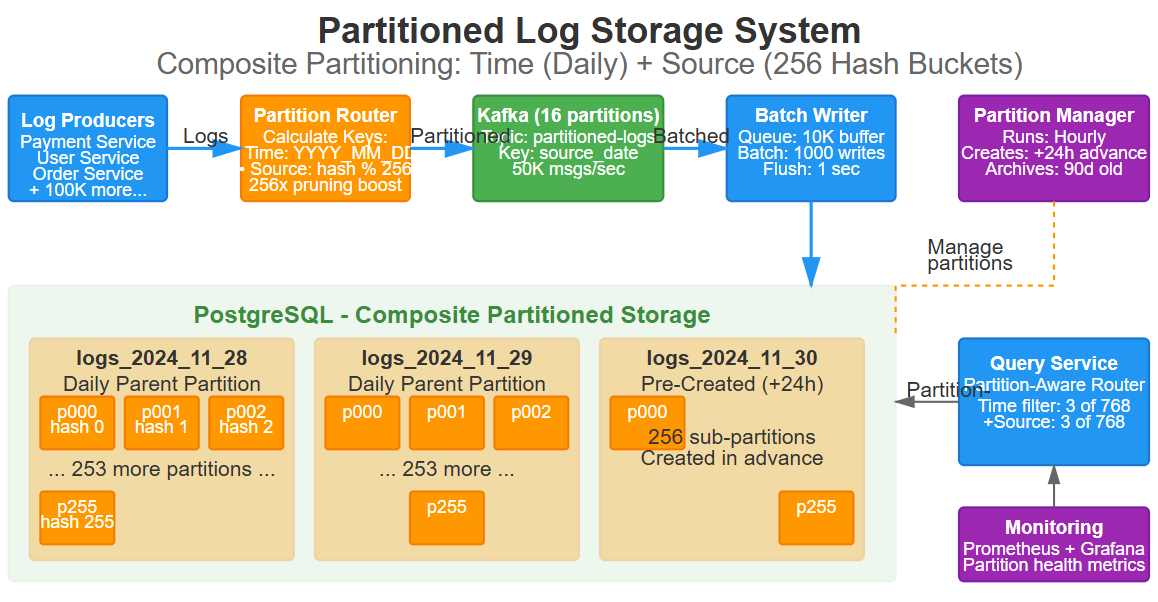
Today we’re implementing intelligent partitioning strategies that transform our multi-node storage cluster from Day 22 into a high-performance distributed log storage system. You’ll build:
Time-based partitioning with automatic daily/hourly partition creation and routing
Source-based partitioning using application identifiers for data locality
Composite partitioning combining time and source for optimal query performance
Partition-aware query router that eliminates full table scans across nodes
Automated partition lifecycle management with retention policies and archival
Why This Matters: The Query Performance Crisis
Without partitioning, every query against your distributed log storage requires scanning all data across all nodes. At Netflix scale (processing 500 billion events daily), a simple “find errors from the payment service in the last hour” query would scan petabytes of irrelevant data. Partitioning solves this by creating physical data boundaries that dramatically reduce query scope.
The real-world impact is staggering. Uber’s logging infrastructure reduced query times from minutes to milliseconds by implementing time-based partitioning—their analytics queries went from scanning 100TB to scanning 10GB. Amazon’s CloudWatch Logs uses composite partitioning (time + log group) to serve billions of queries daily while keeping p99 latency under 100ms. The pattern is universal: partition data by query access patterns, not by storage convenience.
The critical insight: partitioning isn’t just about performance—it’s about making distributed systems economically viable. Without it, you’d need 100x the compute resources to achieve the same query performance.