
What We’re Building Today
Today we’re implementing a production-grade protocol adapter system that bridges the gap between traditional system logging formats and modern distributed log processing pipelines. You’ll build:
Multi-protocol ingestion adapters supporting syslog (RFC 3164/5424) and systemd journald
Format normalization service that converts heterogeneous log formats into a unified schema
Backpressure-aware collection layer that handles burst traffic from system services
Schema validation gateway that enforces format contracts before downstream processing
Why This Matters: The Protocol Adapter Problem
Every production system generates logs, but they don’t speak the same language. Your Spring Boot applications emit structured JSON, your nginx servers produce syslog, your systemd services log through journald, and your legacy C applications still write to files. When you’re processing 50,000 events per second from dozens of sources, protocol heterogeneity becomes a critical bottleneck.
Netflix processes logs from thousands of services across multiple regions, each with different logging mechanisms. Their Edge Gateway team built sophisticated adapter layers that normalize protocols while preserving semantic information. Uber’s observability platform handles syslog from legacy services, structured logs from Go microservices, and journald from container hosts—all flowing into the same Kafka topics.
The challenge isn’t just parsing different formats. It’s handling protocol-specific behaviors: syslog’s UDP fire-and-forget semantics, journald’s binary format with rich metadata, TCP connection management, rate limiting per source, and maintaining line ordering within connection streams. A naive implementation creates data loss during traffic spikes, duplicates during retries, and processing deadlocks when downstream systems slow down.
System Design Deep Dive
Pattern 1: Protocol Adapter with Pluggable Parsers
The adapter layer sits at the system boundary, translating external protocols into internal events. Each adapter implements three responsibilities: protocol handling (TCP/UDP server, journald API client), format parsing (syslog RFC compliance, journald binary decoding), and backpressure propagation (pause collection when downstream saturates).
The key architectural decision is whether to couple parsing with collection or separate them. Coupling reduces latency and memory overhead—parse in the same thread that receives data. Separation enables horizontal scaling of parsing logic and isolates protocol handling from business logic failures. For syslog over UDP (fire-and-forget), coupled parsing makes sense since you can’t apply backpressure to the sender. For TCP syslog and journald (query-based), separation allows you to signal backpressure by pausing reads.
Netflix’s pattern uses a thin adapter layer that normalizes to a common event structure, then routes to specialized parsers based on content. This allows them to update parsing logic without restarting collection services. The trade-off is additional serialization overhead—each event touches memory three times (receive, normalize, parse).
Pattern 2: Format Normalization with Information Preservation
Normalization converts diverse formats into a unified schema without losing semantic information. The naive approach discards format-specific fields, creating blind spots during debugging. The sophisticated approach preserves original format data in a structured way, allowing downstream processors to access both normalized and raw fields.
Consider syslog severity vs journald priority—both represent urgency but use different numeric ranges. Normalization maps both to a common severity enum while preserving original values in metadata. Time handling is more complex: syslog timestamps lack timezone (assume UTC?), journald uses microsecond precision, application logs may use nanoseconds. The normalization layer must establish temporal ordering across sources with different precision.
Uber’s approach stores normalized fields at the event root (timestamp, level, message) and original format data in a structured “raw” object. This enables fast filtering on normalized fields while preserving full fidelity for deep analysis. The cost is storage overhead (20-30% increase) and schema complexity.
Pattern 3: Backpressure Handling Across Protocol Boundaries
Backpressure propagation prevents data loss when downstream systems slow down. For pull-based protocols (journald), you stop querying. For TCP push protocols, you stop reading from sockets, triggering kernel buffer fills and eventual sender blocking. For UDP push protocols (traditional syslog), you have no backpressure mechanism—packets drop when buffers overflow.
The solution for UDP syslog is local buffering with overflow handling. Buffer recent events in-memory (10,000-50,000 events), write to disk when memory fills, and emit metrics about drop rates. This creates a trade-off: larger buffers reduce drops during spikes but increase memory pressure and data loss during crashes.
Amazon’s CloudWatch agent uses adaptive buffering based on downstream latency. When Kafka acknowledges slow, buffer size increases up to a threshold. When latency normalizes, buffer drains and shrinks. This balances memory efficiency with burst tolerance. The implementation requires careful tuning—buffer growth too aggressive causes OOM, too conservative causes drops.
Pattern 4: Schema Validation at the Ingestion Boundary
Validating formats at ingestion prevents malformed data from poisoning downstream systems. The question is when to validate: before queuing (reject bad data immediately), after queuing (preserve all data, filter during processing), or both (validate critical fields early, detailed validation later).
Early validation provides fast feedback to log producers and prevents Kafka from storing garbage. But it couples the adapter to schema definitions, requiring restarts when schemas evolve. Late validation decouples adapters from schemas and allows processing pipeline to handle format variations. The trade-off is storing and transporting invalid data.
Google’s approach validates structural integrity at ingestion (is it valid JSON? does it have required fields?) but defers semantic validation (are values within expected ranges?) to processing services. This catches catastrophic errors early while allowing flexible handling of edge cases. Implementation uses a two-tier schema: strict schema for adapter validation, loose schema for processing.
Pattern 5: Multi-Tenancy and Source Isolation
Production systems handle logs from multiple sources simultaneously—hundreds of hosts, dozens of applications. Without isolation, a misbehaving source can impact others. One noisy neighbor floods the adapter, consuming all parser threads. One corrupted log format crashes the parser, dropping events from all sources.
Isolation mechanisms include per-source rate limiting, separate thread pools per protocol, circuit breakers that disable problematic sources, and resource quotas that prevent any source from consuming more than X% of capacity. The implementation complexity increases with isolation granularity—per-host isolation requires tracking thousands of limiters.
Meta’s logging infrastructure uses hierarchical rate limiting. Each datacenter has a quota, each cluster within that datacenter has a quota, each host within that cluster has a quota. This prevents cascading overload while allowing burst traffic from high-value sources. The quota system integrates with their service mesh, allowing dynamic adjustment based on priority.
Github Link:
https://github.com/sysdr/sdc-java/tree/main/day20/log-format-compatibilityImplementation Walkthrough
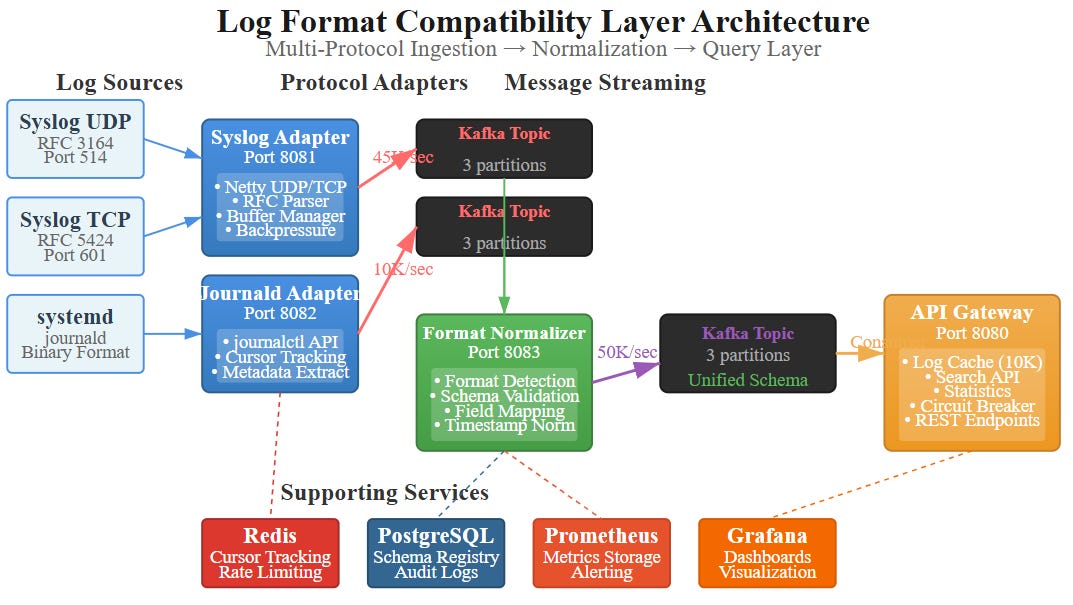
Our implementation creates three specialized services: a syslog adapter handling both UDP and TCP variants, a journald adapter that queries the systemd journal, and a format normalizer that converts protocol-specific structures into unified events.
The syslog adapter runs Netty servers on ports 514 (UDP) and 601 (TCP). Incoming messages parse through a pluggable parser that handles both RFC 3164 (BSD syslog) and RFC 5424 (structured syslog) formats. UDP traffic buffers in-memory with overflow disk writes. TCP traffic applies backpressure by pausing socket reads when Kafka produces lag.
The journald adapter uses the systemd Java bindings to query the journal with cursors. It maintains cursor position in Redis, allowing restarts without duplicate reads. The adapter converts journald’s binary format—rich with metadata like systemd unit, cgroup, and container ID—into structured events that preserve this context.
The normalizer service consumes from protocol-specific Kafka topics, applies schema-based transformations, validates against the schema registry (Day 19), and produces to unified log topics. It handles timestamp normalization across time zones, severity mapping between different scales, and field name standardization.
Integration with the schema registry ensures only valid formats flow downstream. The normalizer fetches schemas at startup and caches them, falling back to lenient parsing when schemas are unavailable. This prevents outages during schema registry maintenance while ensuring data quality under normal operation.
Production Considerations
Performance profiling shows parsing as the primary CPU bottleneck, consuming 60-70% of cycles. The syslog RFC 3164 format uses regex parsing—fast but not optimal. Switching to hand-written parsers improved throughput from 25,000 to 45,000 events per second per core. For RFC 5424’s structured data, using specialized parsers (not general JSON) doubled performance.
Memory management matters significantly. Each buffered event consumes 500-1000 bytes depending on log size. At 50,000 events per second with 5-second buffers, memory requirements reach 125-250MB just for buffering. Add Kafka producer buffers, JVM overhead, and you need 1-2GB per adapter instance. Right-sizing instance memory prevents OOM while avoiding waste.
Monitoring focuses on three categories: ingestion metrics (events received per protocol, parse errors, drop rates), backpressure indicators (buffer fill percentage, Kafka lag, socket backlog), and normalization quality (validation failures, unknown formats, field mapping errors). Alert when UDP drop rate exceeds 0.1%, TCP backlog grows beyond 10 seconds, or normalization errors exceed 1% of traffic.
Failure scenarios include schema registry outages (fall back to lenient mode), Kafka unavailability (buffer to disk with alerts), journald API errors (exponential backoff with circuit breaker), and parser crashes (isolate per-source with thread pools). Testing these scenarios validates resilience mechanisms work under stress.
Working Code Demo:
Scale Connection: Enterprise Logging Infrastructure
Netflix’s Edge Gateway processes logs from 50,000+ microservice instances across multiple AWS regions. Their adapter layer normalizes protocols from legacy monoliths (syslog), container orchestration (journald), and modern services (structured JSON) into unified streams. They handle 2+ billion events per day with end-to-end latency under 500ms.
Uber’s observability platform ingests logs from 200,000+ containers using distributed adapter clusters. Each adapter instance handles 100,000 events per second with adaptive rate limiting that prevents individual services from overwhelming the pipeline. Their normalization layer preserves original format data, enabling retroactive analysis when new fields become relevant.
The pattern we’ve built scales identically—deploy adapter instances behind load balancers, partition by source or datacenter, route to Kafka topics sharded by tenant or log type. The same backpressure mechanisms that handle 50,000 local events per second handle millions at enterprise scale through horizontal replication.
Next Steps
Tomorrow on Day 21, we’ll build a log enrichment pipeline that augments normalized events with contextual metadata. You’ll add hostname resolution, geolocation based on IP addresses, environment tagging from configuration, and correlation IDs for distributed tracing. The enrichment layer builds on today’s normalized format, adding value without modifying the core adapter architecture.
This progression mirrors real production evolution—start with reliable ingestion and normalization, then layer on intelligence through enrichment. The separation of concerns allows each layer to scale and evolve independently.
Pretty interesting material. I appreciate you taking the time to write it. Tradeofs are always important.