What We’re Building Today
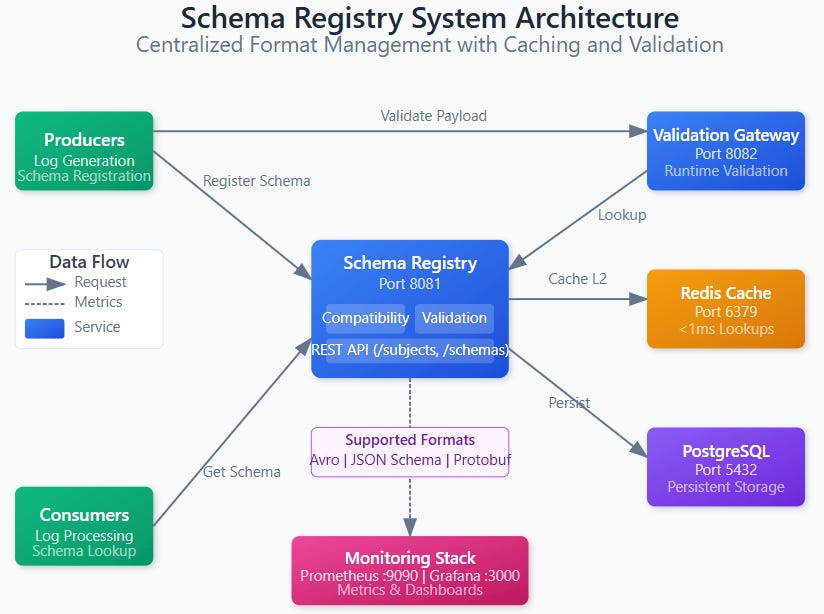
Today you’ll implement a production-grade schema registry service that serves as the central authority for managing and validating log formats across your distributed system:
Schema Registry Service - Central HTTP service storing versioned schemas with PostgreSQL persistence
Compatibility Checking Engine - Validates schema evolution follows backward/forward compatibility rules
Schema Validation Gateway - Runtime validation layer ensuring logs conform to registered schemas
Caching Layer - Redis-backed cache reducing database load for high-throughput validation
Subject Management API - RESTful endpoints for registering, retrieving, and versioning schemas
By session end, you’ll have a registry handling 10,000+ schema lookups per second with sub-millisecond cached responses.
Why This Matters
Every distributed system eventually faces schema hell. Team A deploys a producer adding a new field. Team B’s consumer crashes because it doesn’t recognize it. Team C’s data pipeline writes corrupted records to the data lake. Three teams, three incidents, one root cause: no central schema governance.
Schema registries solve this by establishing a single source of truth for data contracts. Netflix’s schema registry handles millions of daily lookups across 1,000+ microservices. Uber’s Schemaless system validates every payload before persistence. Amazon’s Glue Schema Registry enforces compatibility across their entire data ecosystem.
The pattern matters because distributed systems fail at boundaries. Services evolve independently, but data contracts must evolve together. A schema registry transforms implicit assumptions into explicit, versioned, validated contracts. Without it, you’re hoping every team reads every Slack message about every schema change. With it, incompatible changes fail at registration time, not at 3 AM in production.