
What You’ll Build Today
By the end of this lesson, you’ll have a production-ready log processing system that demonstrates:
Avro-based log serialization with embedded schemas and binary efficiency
Schema Registry integration for centralized schema management and versioning
Backward and forward compatible schemas allowing independent producer/consumer deployment
Schema evolution demonstration showing live migration between schema versions without downtime
Why Schema Evolution Matters
Yesterday’s Protocol Buffers implementation delivered impressive serialization performance, but we deliberately sidestepped one of distributed systems’ most challenging problems: what happens when your data model needs to change?
In monolithic systems, you deploy everything together. Schema changes are coordinated. In distributed systems, you’re managing dozens of services with independent deployment schedules. When Netflix updates how they represent viewing events, they can’t simultaneously redeploy every service that produces or consumes that data—that’s thousands of services across multiple regions.
Schema evolution is the discipline of changing data structures while maintaining compatibility with existing producers and consumers. Avro was designed specifically for this challenge. Unlike Protocol Buffers where schema is compiled into code, Avro transmits schema alongside data (or references it via registry), enabling runtime schema resolution and compatibility checking.
The real insight: schema evolution isn’t just about data format—it’s about organizational velocity. Teams that master schema evolution deploy independently. Teams that don’t coordinate every release, creating bottlenecks that slow the entire organization.
System Design Deep Dive
Schema Registry Architecture
The Schema Registry is the centerpiece of Avro-based systems. Rather than embedding full schemas in every message (expensive at scale), producers register schemas and include only a schema ID with each message. Consumers fetch schemas on-demand and cache them locally.
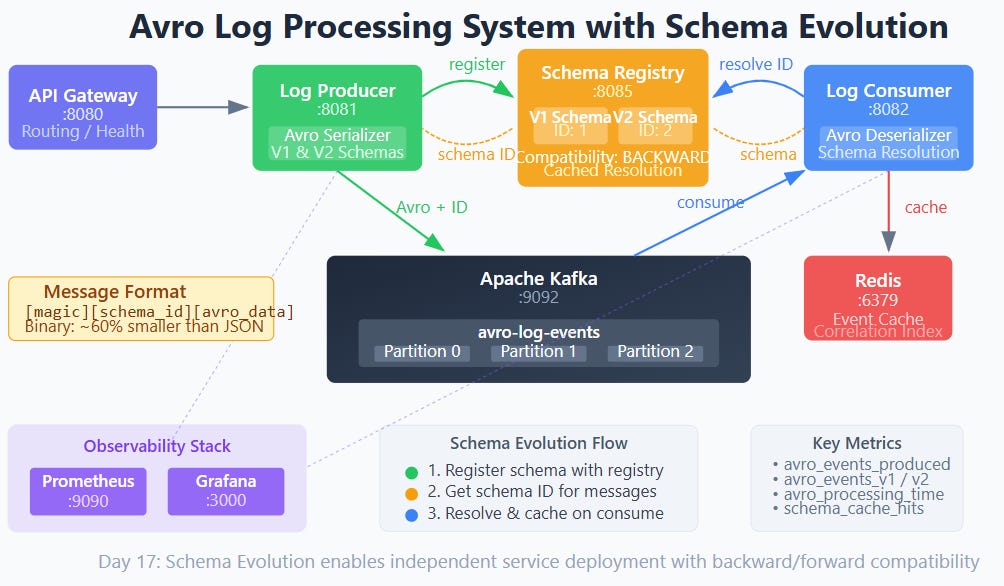
This creates several architectural benefits. First, schemas become a shared contract stored centrally rather than duplicated across codebases. Second, the registry can enforce compatibility rules, rejecting schema changes that would break consumers. Third, you gain visibility into what schemas exist and which services use them.
The trade-off is operational complexity—the registry becomes a critical dependency. If it’s unavailable, new consumers can’t deserialize messages with unfamiliar schema IDs. This is why Confluent’s Schema Registry uses Kafka itself as its backing store, inheriting Kafka’s replication and durability guarantees.
