Day 163: Build Service Dependency Mapping
What We’re Building Today
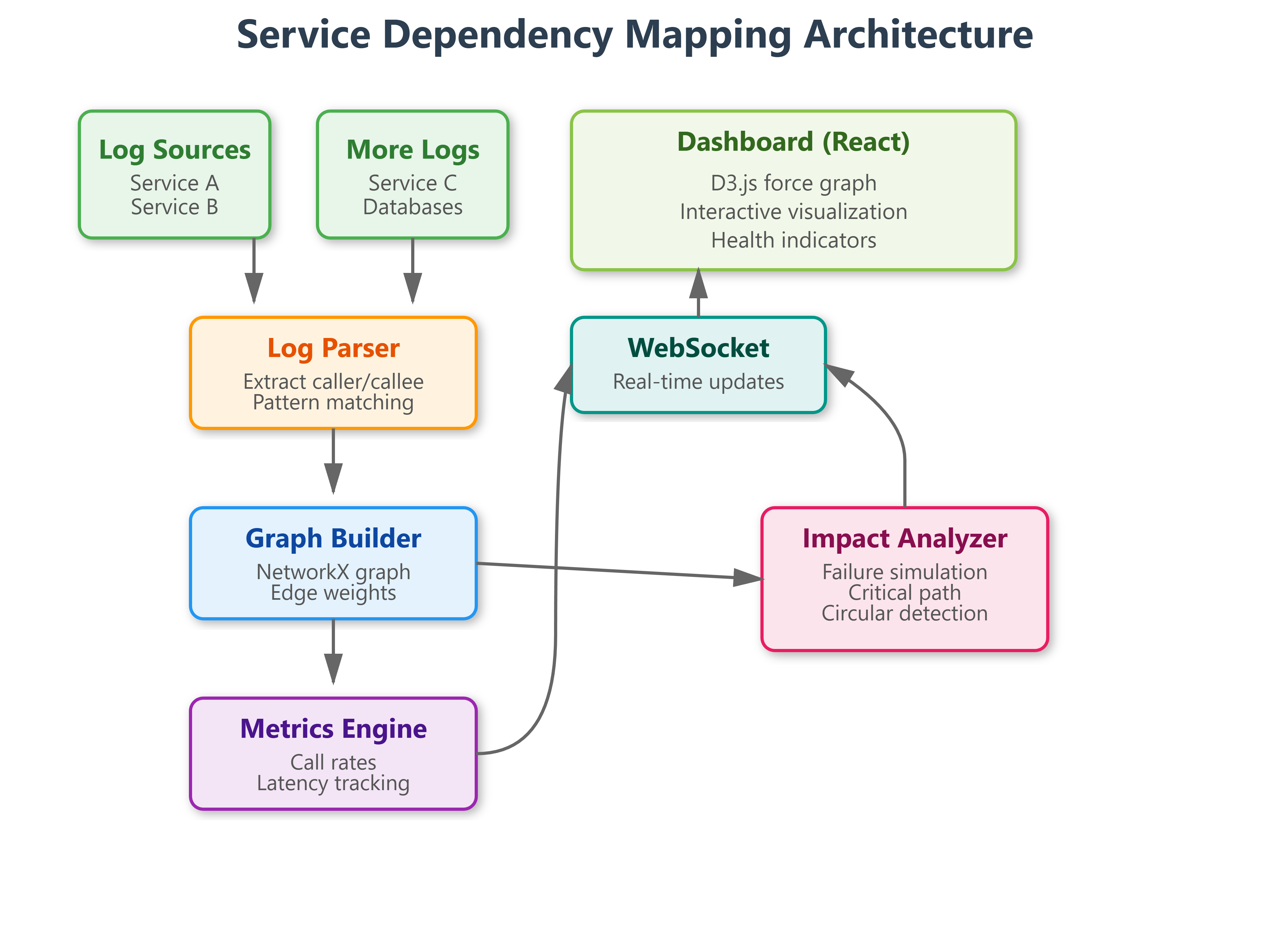
Today we’ll create an automatic service dependency discovery system that analyzes log data to map how services communicate. By parsing API calls, database queries, and message queue events from logs, we’ll build a real-time dependency graph showing which services talk to each other, how frequently, and with what latency.
Key deliverables:
Log parser that extracts service interactions
Graph builder that constructs dependency relationships
Real-time visualization dashboard
Health impact analyzer
Core Concept: Service Dependency Mapping
Service dependency mapping answers a critical question: “If service X goes down, what else breaks?” In production systems like Netflix’s microservices architecture (over 700 services), understanding dependencies prevents cascading failures. When a video transcoding service fails, you need to know it impacts recommendations, search, and playback - not just video uploads.
How it works: Parse logs for interaction patterns (HTTP calls, RPC invocations, database connections), build a directed graph where nodes are services and edges are dependencies, weight edges by call frequency and latency, detect circular dependencies and single points of failure.
Why it matters: Uber processes 40 million rides daily across 1000+ microservices. Without dependency mapping, deploying a payment service update could unknowingly break ride matching. Automated discovery from logs eliminates manual documentation that’s always outdated.