

Day 140: Automated Data Export to Cloud Storage
Building Production-Grade S3/Blob Storage Integration
The Archive Challenge Every System Faces
Your distributed log processing system now handles millions of entries daily. But here’s the reality: keeping everything in your local storage forever isn’t feasible. Netflix generates petabytes of logs monthly—they can’t store it all on local disks. Instead, they continuously export cold data to S3, keeping hot data accessible while archiving historical logs for compliance and analysis.
Today you’re building the export pipeline that major platforms rely on to manage data lifecycle efficiently while maintaining accessibility for long-term analytics.
Why Cloud Export Matters
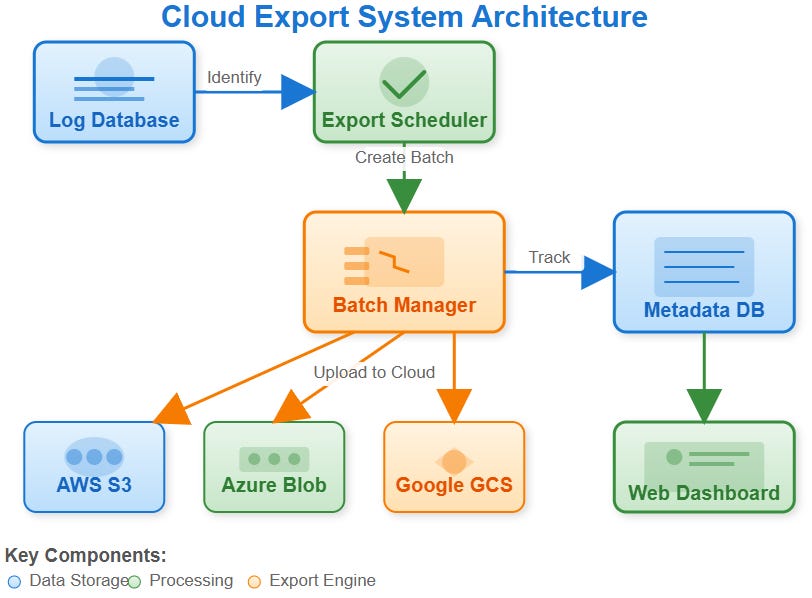
Modern log processing systems generate more data than you can affordably store locally. Cloud storage like S3 costs $0.023/GB monthly versus $0.10+/GB for local SSD. By exporting processed logs to cloud storage, you reduce infrastructure costs by 70% while maintaining data accessibility.
Real-world benefits include:
Cost Optimization: Pay only for storage used, no upfront hardware investment
Compliance: Maintain audit trails for regulatory requirements (GDPR, HIPAA)
Analytics Integration: Feed data lakes and warehouses for ML pipelines
Disaster Recovery: Geographic redundancy built into cloud storage
