
Day 129: Structured Logging Helpers - Making Logs Machine-Readable
Today’s Mission
Yesterday you built logging libraries that transport data across your distributed system. Today we’re tackling the content problem - transforming chaotic log messages into structured, searchable data.
Think of it as giving your logs a professional makeover. Instead of messy Post-it notes scattered everywhere, you’re building an organized filing system where every piece of information has its proper place and can be found instantly.
What You’re Building:
Field validation and normalization engine
Context injection framework
Performance-optimized JSON serialization
Integration adapters for popular frameworks
Real-time validation dashboard
The Structured Logging Revolution
While your Day 128 logging libraries handled the transport layer, today’s helpers solve the content problem. Raw logs like “User login failed for john@example.com“ become structured events with searchable fields, timestamps, and correlation IDs.
Real-world Impact: Netflix processes 1 trillion log events daily. Their structured logging helpers automatically extract user IDs, session tokens, and performance metrics from developer-written messages, enabling instant searches like “show all login failures for premium users in the last hour.”
The Transformation:
BEFORE: “Failed to process payment of $29.99 for user 12345”

AFTER: {
  “event”: “payment_failed”,
  “amount”: 29.99,
  “user_id”: 12345,
  “timestamp”: “2025-05-20T10:30:00Z”,
  “service”: “payment-service”,
  “trace_id”: “abc-123-def”
}
The difference is queryability. Structured logs become database records you can filter, aggregate, and analyze at scale.
System Architecture
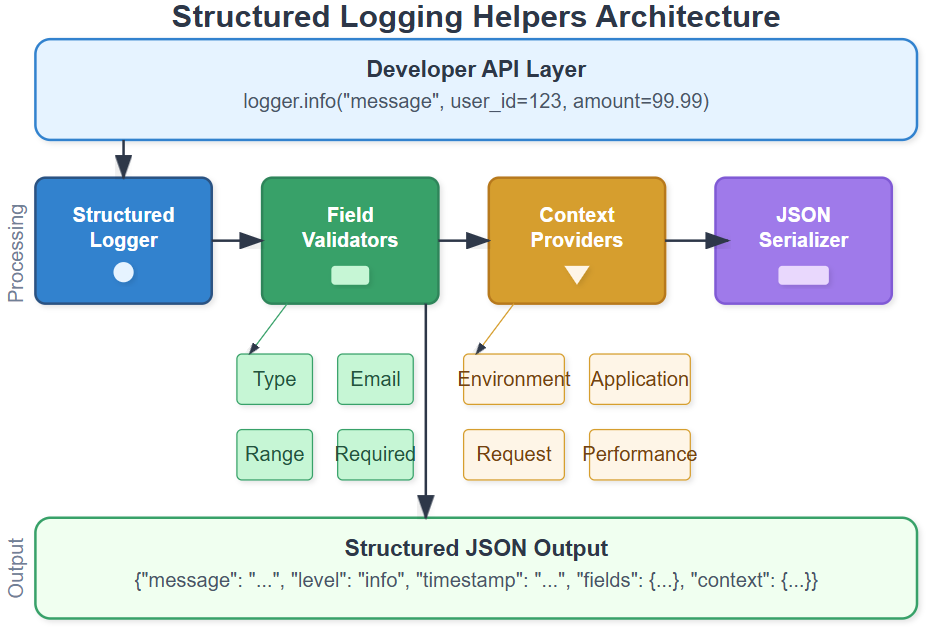
Today’s helpers sit between application code and your Day 128 transport libraries. Developers use helpers to create structured logs, which then flow through your distributed processing pipeline with guaranteed format consistency.
